Songs without words
A few weeks ago I attended a workshop on asemic poetry at the Ashmolean Museum lead by Sascha Akhtar.
The term asemic was coined by visual poets in the 1990s to describe works which have "no semantic content"—poems without words.
Asemic poetry makes use of gestures which look like writing and appear interpretable, but which cannot be read. Small children are the among the most prolific producers of asemic works. Their scribble looks like writing but is indecipherable—though this doesn't prevent their parents from understanding it.

One of the best known European asemic works is the Voynich Manuscript. Created in Renaissance Italy, the book is illustrated with pictures of plants, solar systems, and naked women in a variety of natural pools and extravagant bathrooms. The accompanying text looks like a language; there are repeated gestures resembling letters and symbols. However, despite the best efforts of linguists, cryptographers, and machines, over hundreds of years, the manuscript has resisted all attempts to decipher it.
Asemic works fail unless they retain the visual characteristics of a language whilst eschewing its meaningfulness, though if you think about asemicism long enough,you begin to lose confidence that you can discriminate between what is meaningful and what is not. Some semic texts, such as the highly decorative calligraphic works produced by Chinese and Islamic artists, are so stylised and extravagant that even those fluent in the language being used often experience them as asemic.
I was reminded of standing in small crowd in the British Museum, staring at broken, black stone in a transparent box.

The Rosetta Stone is inscribed with a decree issued in 196 BCE by King Ptolemy V Epiphanes. Like a decree from the European parliament or an instruction booklet, it repeats the same text in different languages, in this case: Ancient Egyptian hieroglyphs, Demotic Egyptian script, and Ancient Greek. At the time of its discovery, no one could read hieroglyphs or demotic script, and the Rosetta Stone became famous as the key to deciphering these languages.
As I stood in the crowd of people, none of whom, I am sure, could read hieroglyphs or Demotic script or Ancient Greek, we responded to it as we would an asemic poem—even though the stone itself is the exact opposite of asemic.
Asemic poems are Daoist; their meaning is the absence of meaning. Dependent on the interpretation of the reader, they can have a common effect on people who do not share a language, and can mean different things to different people who do. They are refreshed in a similar way that texts written in dead languages (such as the Epic of Gilgamesh or the Iliad) are refreshed by new translations.
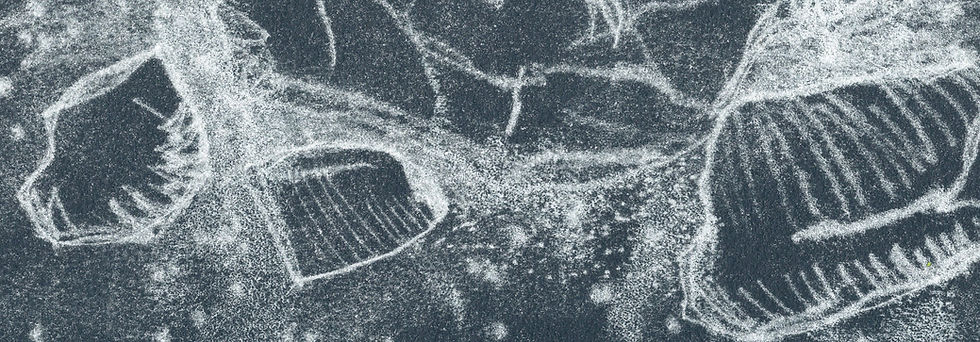
Here are a couple of asemic poems I created on the course.




Comments